Decoding Behavioral Patterns in API-Driven Personalization Engines Across Global User Bases

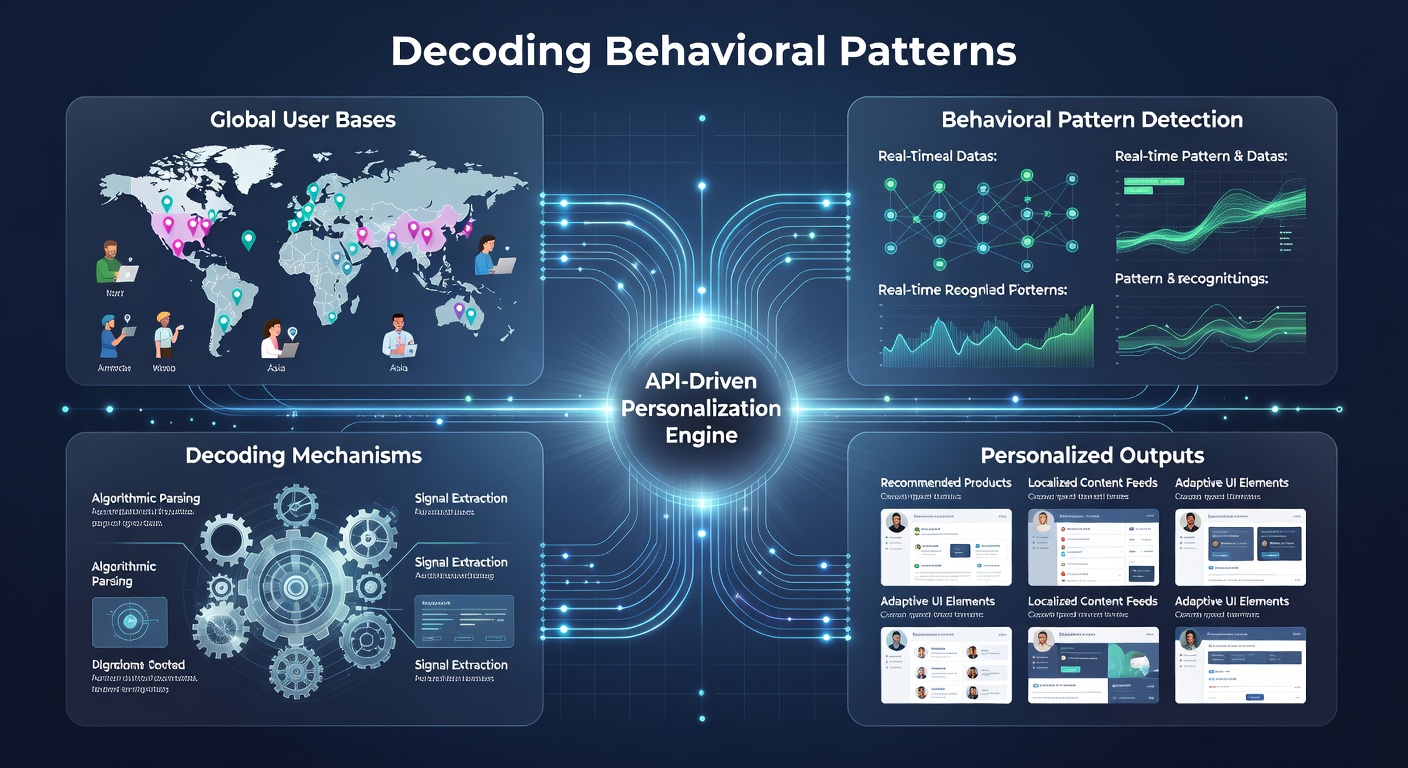
API-driven personalization engines process real-time user interactions to deliver tailored content, and researchers continue to examine the underlying behavioral patterns that emerge when these systems operate at global scale. Data flows through standardized interfaces that connect user devices with backend analytics platforms, which aggregate signals such as click sequences, dwell times, and navigation paths while respecting regional data-handling rules.
Core Mechanics of API Integration in Personalization
Engineers design APIs to expose structured endpoints that capture behavioral telemetry without requiring full page reloads, and this architecture supports continuous model updates across distributed servers. When a user in one region engages with content, the API transmits anonymized event streams that feed into machine-learning pipelines capable of identifying clusters of similar activity patterns, then those clusters inform subsequent content selection for other users who exhibit comparable signals.
Studies from academic institutions show that sequence-based models outperform simpler frequency counts because they preserve temporal order in user actions, and this distinction matters when personalization engines handle traffic from multiple time zones simultaneously. Observers note that latency requirements tighten as geographic distance increases, prompting providers to deploy regional API gateways that preprocess data before it reaches central training clusters.
Regional Variations in Behavioral Signals
Behavioral data collected from Asia-Pacific markets often emphasizes rapid content scanning and high-volume short sessions, whereas patterns observed in European cohorts reflect longer dwell times on detailed product pages and higher rates of comparison shopping. Personalization engines adjust weighting factors accordingly, and these adjustments rely on API calls that pull localized preference models trained on historical interactions within each jurisdiction.
Figures released by regulatory bodies indicate that compliance frameworks shape which signals remain available for analysis, and organizations operating across borders maintain separate data pipelines to satisfy distinct legal obligations. In May 2026, updates to cross-border data transfer mechanisms in several jurisdictions prompted developers to refine API authentication layers, thereby reducing the volume of raw behavioral logs that cross regional boundaries while preserving the statistical integrity needed for pattern detection.
Pattern Recognition Techniques and Their Global Reach
Machine-learning practitioners apply clustering algorithms that group users by behavioral similarity rather than demographic labels alone, and this approach surfaces unexpected correlations such as shared navigation rhythms between users in urban centers of different continents. API responses return ranked recommendations derived from these clusters, and the ranking logic incorporates feedback loops that update weights after each interaction cycle.
One study revealed that incorporating session-duration variance as a feature improved prediction accuracy for return visits, while another analysis demonstrated that click-heatmap distributions differ measurably between mobile-first and desktop-dominant regions. Those who've examined production logs across multiple deployments report that seasonal events produce detectable spikes in exploratory behavior that persist for several days after the event concludes.
Data Governance and Cross-Border Considerations
Industry reports document the adoption of differential privacy techniques within API layers to limit re-identification risks when behavioral datasets are combined from disparate sources. Organizations reference guidance from the European Data Protection Board when calibrating noise levels added to aggregated statistics, and similar principles appear in frameworks issued by authorities in Canada and Australia. These measures allow personalization engines to maintain global model performance without exposing individual-level traces that could violate local statutes.
What's interesting is how API versioning strategies enable gradual rollout of new pattern-detection features; teams can test updated clustering logic on limited geographic cohorts before expanding exposure. Data shows that such staged deployments reduce the incidence of recommendation mismatches that arise when cultural context is inadequately represented in training data.
Future Trajectory of Pattern Analysis
Engineers continue to explore graph-based representations that model relationships between sequential actions rather than treating each event in isolation, and early deployments indicate improved handling of multi-device journeys that span different regions. Observers note ongoing work on federated learning approaches that keep raw behavioral data localized while still contributing to shared global models through API-mediated parameter exchanges.
Conclusion
Decoding behavioral patterns within API-driven personalization engines requires coordinated attention to technical architecture, regional regulatory environments, and evolving user interaction styles. As systems scale across borders, the ability to maintain accurate, privacy-respecting pattern detection depends on continued refinement of data pipelines and analytical methods that accommodate both universal tendencies and localized nuances.