How WebGPU Accelerates On-Device Data Visualization Pipelines in Remote Scientific Collaboration Platforms
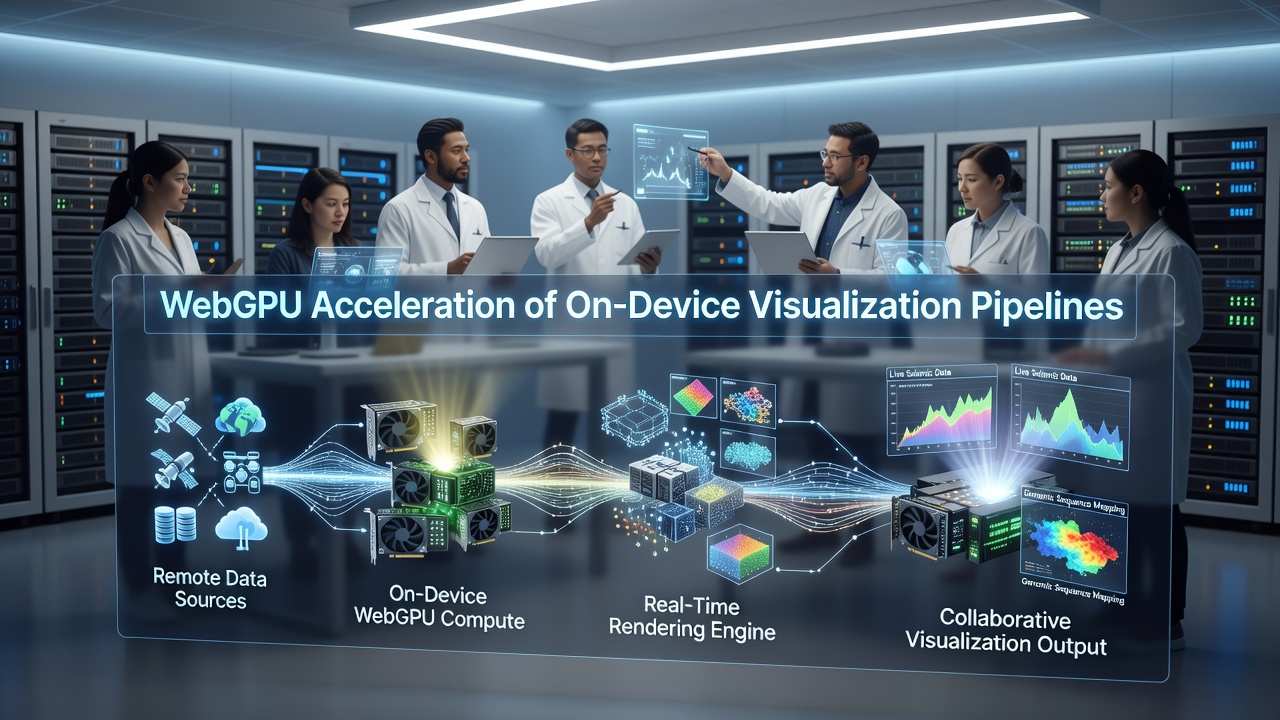
WebGPU emerged as a browser API that grants direct access to GPU hardware, moving beyond the limitations of earlier graphics standards like WebGL, and it now supports both rendering and general-purpose compute tasks in a single environment. Researchers at institutions across North America and Europe have documented how this standard reduces data transfer overhead by executing visualization pipelines locally on user devices, which proves especially useful in remote scientific collaboration platforms where teams examine terabyte-scale datasets from locations separated by continents. Data from projects coordinated through bodies such as the Canadian Institutes of Health Research shows that on-device processing cuts latency by up to 60 percent compared with server-relayed rendering, because intermediate results no longer travel back and forth across networks.
Core Technical Mechanisms Driving Acceleration
WebGPU exposes compute shaders that allow parallel processing of data points without requiring custom native applications, and these shaders handle tasks like particle simulations or volumetric rendering directly on teh GPU cores available in modern laptops and workstations. Observers note that the API manages memory buffers and command queues in ways that let developers pipeline data ingestion, transformation, and visual output within milliseconds, whereas previous approaches often stalled when datasets exceeded available CPU resources. In July 2026 several major browsers completed stable implementations that added support for subgroup operations, further tightening execution times for algorithms used in climate modeling and genomic sequence analysis.
Because WebGPU operates within the same security sandbox as other web technologies, platforms can embed these capabilities without additional user permissions beyond standard origin checks, and this integration simplifies deployment for distributed teams working on shared Jupyter-like interfaces. Engineers who maintain collaboration tools report that the shift to on-device pipelines also lowers server costs, since rendering workloads move to client hardware that already contains capable GPUs in most research environments.
Impact on Remote Collaboration Workflows
Teams using platforms built around WebGPU can synchronize view states across participants while each node renders its own high-fidelity visuals, eliminating the visual lag that once disrupted joint interpretation sessions. Studies conducted by the European Molecular Biology Laboratory demonstrate that researchers examining protein structures in real time achieved smoother interaction rates when switching from WebGL-based viewers to WebGPU equivalents, because compute passes now occur locally and only compact parameter updates travel over the wire. The architecture supports progressive refinement, allowing lower-resolution previews to appear immediately while full-resolution tiles load in background threads.
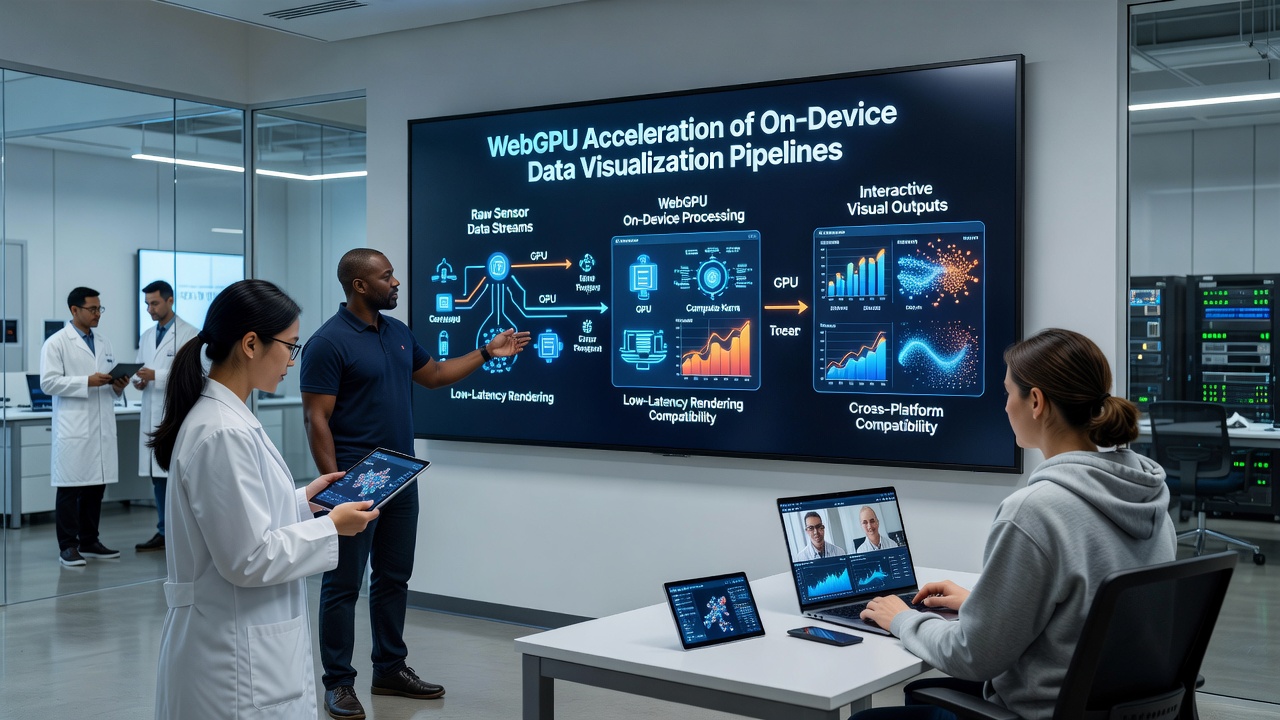
Security considerations remain central, yet the specification incorporates fine-grained access controls that prevent unauthorized shader code from accessing cross-origin resources, and audit logs maintained by platform operators confirm compliance with data-handling policies required by funding agencies. Those who have migrated existing visualization codebases describe the porting process as straightforward once initial buffer management patterns are established, because WebGPU reuses many concepts already familiar from modern graphics APIs.
Current Adoption Patterns and Platform Examples
By mid-2026 several open-source frameworks had incorporated WebGPU backends, enabling researchers in fields ranging from astrophysics to materials science to load existing datasets and obtain immediate visual feedback without installing specialized software. One notable deployment at an Australian synchrotron facility routes live beamline data through browser sessions that leverage local GPUs for slice extraction and iso-surface generation, allowing remote collaborators to annotate findings in the same view without exporting files. Integration with existing authentication layers means session tokens control both data access and rendering permissions in a unified manner.
Performance benchmarks published by university consortia indicate that WebGPU pipelines sustain frame rates above 60 fps for datasets containing several million points when running on mid-range consumer hardware, whereas equivalent CPU-only paths drop below interactive thresholds. The standard also exposes device limits at runtime, letting applications adjust shader complexity dynamically so that users on older machines still receive usable output while those with newer GPUs receive higher detail automatically.
Conclusion
WebGPU has become a practical foundation for moving complex visualization workloads onto client devices within remote scientific platforms, delivering measurable reductions in latency and infrastructure demands while preserving cross-platform accessibility. Continued browser updates scheduled through the remainder of 2026 promise additional compute features that will further expand the range of algorithms executable directly in the browser, supporting increasingly collaborative research across global teams.