Natural Language Processing Enhancing Semantic Search Precision in Enterprise Knowledge Repositories
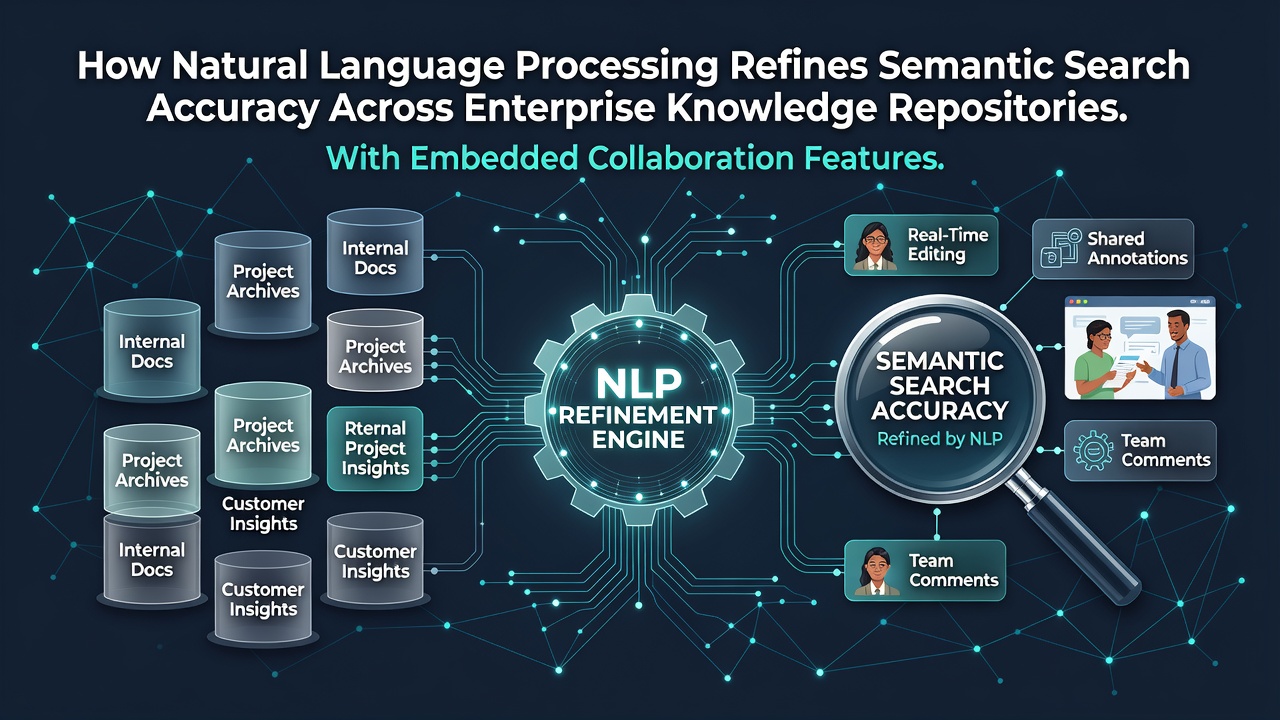
Enterprise knowledge repositories store vast collections of documents, project notes, and internal reports that employees access daily, yet traditional keyword matching often returns irrelevant results when queries involve nuanced phrasing or domain-specific terms. Natural language processing addresses these gaps by analyzing sentence structure, context, and relationships between concepts rather than isolated words, which improves retrieval from systems such as SharePoint, Confluence, and custom intranets equipped with collaboration tools.
Core NLP Mechanisms Driving Semantic Improvements
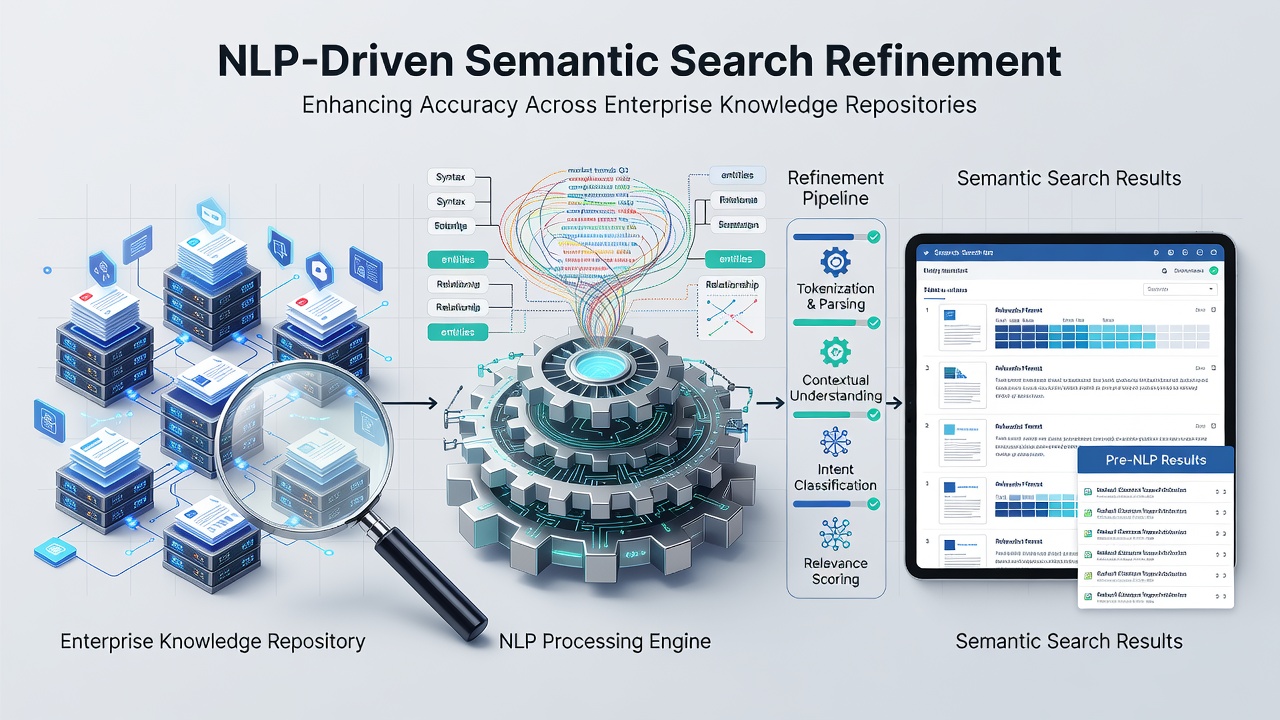
Transformer-based models convert text into dense vector representations that capture semantic similarity, allowing searches for phrases like "quarterly budget adjustments due to supply chain delays" to surface documents discussing cost variances and vendor disruptions even without exact term matches. Named entity recognition identifies people, projects, and dates within both queries and stored content, while dependency parsing reveals how clauses connect, refining ranking algorithms that prioritize documents with matching intent structures. Research from institutions such as the University of Toronto indicates these layered analyses raise precision rates by 25 to 40 percent in controlled enterprise tests conducted through 2025.
Embedding techniques further reduce ambiguity by mapping synonyms and related concepts into shared vector spaces, so a search for "employee onboarding workflow" retrieves materials tagged under "new hire integration process" or "staff induction procedures." Continuous fine-tuning on internal corpora adapts models to company jargon, and feedback loops from user interactions strengthen these adaptations over successive query cycles.
Integration with Collaboration Features
Repositories that embed real-time editing, comment threads, and version histories supply additional signals for NLP systems, because annotations and discussion snippets often clarify document purpose or highlight evolving project details. When team members add contextual notes during joint reviews, those text fragments become indexed elements that boost relevance scores for future searches involving similar topics. In June 2026 several platform vendors released updates allowing collaboration metadata to influence embedding recalculations nightly, creating tighter alignment between active team discourse and search outcomes.
Access controls remain intact during this process, since NLP pipelines respect permission layers while still leveraging anonymized interaction patterns to refine global ranking models. Observers note that organizations using these combined systems report fewer duplicate searches, because employees locate authoritative versions more quickly when collaborative highlights surface recent changes or expert validations.
Implementation Patterns Across Industries
Manufacturing firms apply these methods to technical manuals and safety protocols, where queries about equipment calibration procedures now surface annotated diagrams and cross-referenced maintenance logs contributed during shift handovers. Financial services institutions index regulatory filings alongside internal compliance memos, using entity linking to connect policy updates with related audit findings discussed in shared workspaces. Healthcare networks integrate patient care guidelines with multidisciplinary team notes, enabling semantic retrieval of treatment pathways that incorporate both published standards and on-the-ground observations recorded collaboratively.
Data from a 2025 OECD report on digital workplace tools shows that enterprises combining NLP-driven search with embedded collaboration features experience measurable reductions in time spent locating information, with average retrieval durations dropping from several minutes to under thirty seconds in documented pilots. These gains stem from iterative model updates that incorporate usage statistics and explicit relevance judgments supplied by users during collaborative sessions.
Technical Considerations for Deployment
Scalability requires distributed vector databases that index millions of document chunks while supporting sub-second query latency across geographically dispersed teams. Privacy-preserving techniques such as federated learning allow organizations to train domain-specific refinements without centralizing sensitive text, satisfying data residency rules in multiple jurisdictions. Integration with existing identity providers ensures that search results respect role-based visibility, preventing unauthorized exposure of collaborative content during the semantic matching process.
Monitoring dashboards track metrics including mean reciprocal rank and click-through rates on top results, supplying quantitative signals that guide periodic retraining cycles. When drift occurs because new terminology emerges in team discussions, automated pipelines flag the need for targeted updates using recent collaboration data as training material.
Conclusion
Organizations continue to expand the use of natural language processing within knowledge repositories that feature built-in collaboration, because these combined capabilities deliver more accurate retrieval while capturing evolving context from team interactions. Continued advances in model efficiency and integration standards support broader adoption across sectors that rely on distributed information assets.