Navigating the Shift to Zero-Trust Models in Cloud-Based Web Services
Cloud-based web services have expanded rapidly over the past decade, and the security perimeter that once protected enterprise networks has dissolved under the weight of distributed users, devices, and applications. Organizations now authenticate every request regardless of origin because attackers routinely exploit trusted internal pathways to reach sensitive data.
Core Principles Behind Zero-Trust Deployment
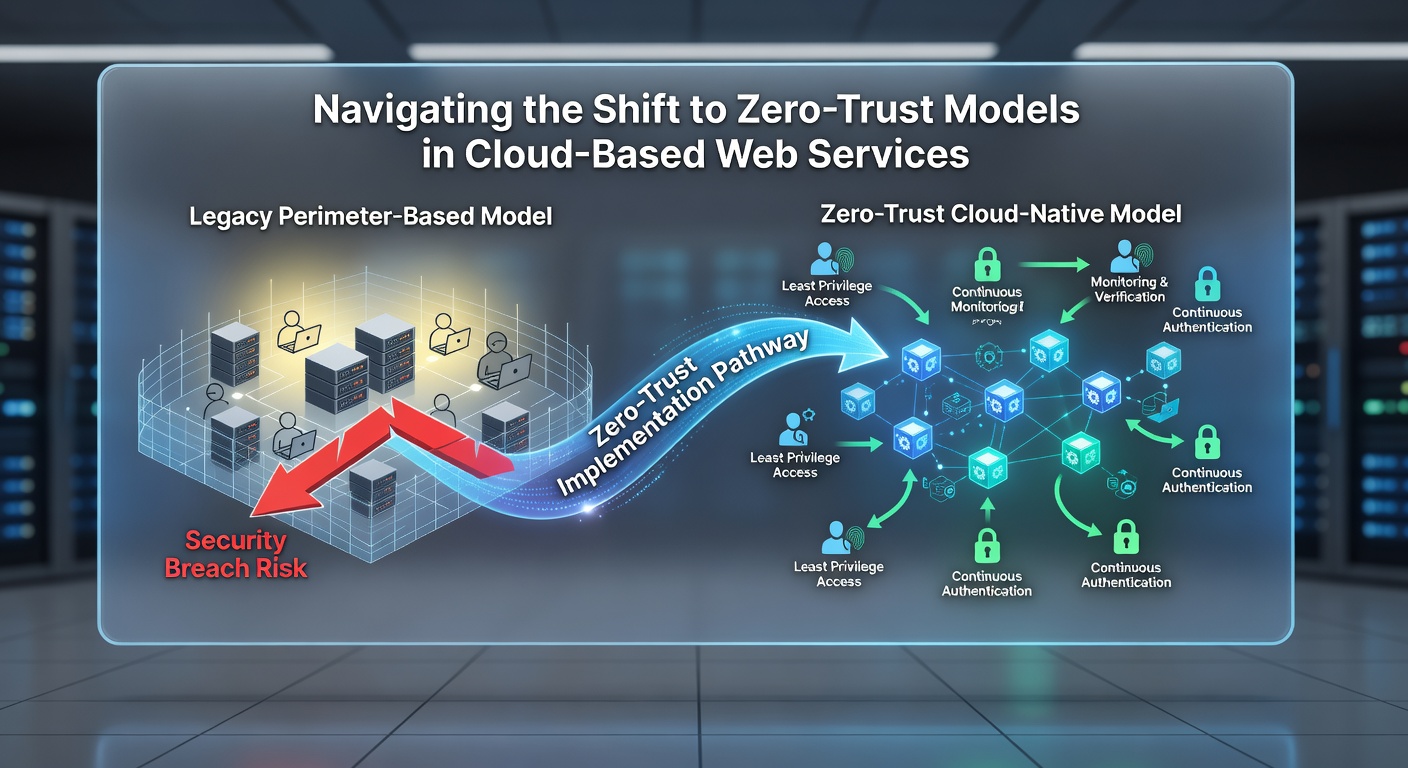
Zero-trust architecture rests on three foundational ideas that replace implicit trust with explicit verification at every step. First, no user or system receives blanket access simply because it resides inside a corporate network; instead, each interaction triggers identity checks, device posture assessments, and real-time risk scoring. Second, least-privilege access limits exposure so that compromised credentials grant attackers only narrow slices of functionality rather than broad administrative rights. Third, continuous monitoring and analytics detect anomalous behavior before damage spreads, turning every transaction into an opportunity for validation.
These principles translate directly into cloud environments where microservices communicate across multiple regions and containers spin up on demand. Engineers implement them through identity providers, policy engines, and encrypted tunnels that enforce rules without relying on static IP ranges or VPN concentrators.
Drivers Accelerating Adoption in 2026
Regulatory pressure has intensified since major data-protection frameworks began requiring explicit access controls across cloud workloads. In May 2026 several jurisdictions updated compliance checklists to include zero-trust controls for any organization handling personal or financial information through public cloud providers. At the same time, breach reports published by government agencies show that lateral movement inside cloud tenants accounts for an increasing share of successful attacks, prompting security teams to redesign network segmentation.
Industry research from the Cloud Security Alliance and academic studies at institutions such as Carnegie Mellon University further document how hybrid work patterns keep traffic flowing outside traditional boundaries, making location-based trust obsolete. These combined forces have pushed zero-trust projects from pilot status into production roadmaps across finance, healthcare, and retail sectors.
Practical Steps for Implementation
Teams begin by inventorying every workload, API endpoint, and data store that operates in cloud environments, then map the exact data flows between them. Next they deploy strong identity foundations such as federated authentication tied to hardware-backed keys so that service accounts and human users prove identity before each session. Policy engines then evaluate context including device health, location anomalies, and behavioral baselines to grant or deny access in real time.
Network controls shift from perimeter firewalls to software-defined micro-segmentation that isolates individual services, while all traffic moves over mutually authenticated TLS connections. Logging pipelines feed into centralized analytics platforms that apply machine-learning models to spot deviations within minutes rather than days. Organizations that follow this sequence report measurable reductions in dwell time once incidents occur, according to figures released by the Australian Cyber Security Centre.
Common Obstacles and Mitigation Tactics
Legacy applications often lack native support for modern identity protocols, forcing teams to introduce sidecar proxies or API gateways that intercept traffic without rewriting core code. Performance overhead appears when every request travels through additional verification layers, yet caching of policy decisions and hardware-accelerated encryption keep latency within acceptable limits for most web workloads. Skill gaps also surface because architects must master both cloud-native tooling and continuous authentication frameworks, prompting many firms to invest in targeted training programs rather than attempting wholesale staff replacement.
Budget concerns arise early in planning because initial tooling and integration costs exceed those of traditional perimeter solutions. Over longer horizons, however, reduced breach impact and simplified compliance audits offset those upfront expenditures, data from multiple enterprise surveys indicates.
Measuring Progress and Sustaining the Model
Success metrics focus on time-to-detect, time-to-contain, and the percentage of traffic covered by least-privilege policies rather than on simple firewall rule counts. Dashboards track policy violations, failed authentications, and anomalous data transfers, giving security operations centers actionable signals without drowning analysts in raw logs. Regular tabletop exercises and red-team assessments validate that controls continue to function after cloud platform updates or new service introductions.
Conclusion
The move to zero-trust models in cloud-based web services represents a structural change in how access decisions occur at every layer of the stack. Organizations that methodically inventory assets, enforce continuous verification, and integrate monitoring across providers position themselves to handle both current threats and those that emerge as cloud architectures evolve further. Data from regulatory bodies and research institutions shows measurable improvements in containment times once these controls reach maturity, confirming that the approach scales beyond initial pilot deployments into enterprise-wide standards.