Quantum-Resistant Algorithms Bolstering Data Integrity Checks Within Serverless Function Deployments for Real-Time Inventory Tracking Platforms

Quantum computing advances continue to reshape security considerations for distributed systems, and organizations managing real-time inventory tracking now examine quantum-resistant algorithms as a means to strengthen data integrity within serverless function deployments. These platforms process continuous streams of stock level updates, order fulfillment events, and supply chain signals across multiple regions, where any compromise in verification mechanisms could disrupt operations. Lattice-based cryptographic constructions and hash-based signature schemes form the core of post-quantum approaches that researchers have tested against both classical and emerging quantum attack vectors.
Serverless environments execute code in ephemeral containers triggered by events such as database writes or API calls, which creates specific requirements for integrity checks that must complete without introducing latency into inventory reconciliation processes. Data integrity verification occurs at each function invocation boundary, confirming that transmitted stock quantities and location identifiers have not been altered during transit or storage. Traditional digital signature methods based on elliptic curve or RSA mathematics face theoretical vulnerability once large-scale quantum computers become available, prompting migration efforts toward algorithms standardized by bodies including the National Institute of Standards and Technology.
Post-Quantum Cryptography Standards and Inventory Use Cases
Standardization activities reached a notable milestone when NIST finalized initial post-quantum algorithm selections, and subsequent implementation guides released around June 2026 outlined deployment patterns suitable for event-driven architectures. CRYSTALS-Dilithium and Falcon signature schemes provide the verification primitives now integrated into several cloud function runtimes, allowing inventory platforms to attach quantum-resistant signatures to each update packet without requiring persistent key storage within individual function instances. Hash-based methods such as SPHINCS+ offer an alternative path for applications where signature size carries less weight than long-term security assurances.
Real-time inventory systems often combine these signatures with message authentication codes derived from quantum-resistant key exchange protocols, ensuring both authenticity and freshness of stock data. One logistics provider documented a 14 percent reduction in reconciliation discrepancies after replacing classical signatures with lattice-based variants across its serverless order-processing pipeline, according to internal metrics shared with industry analysts. The change involved wrapping existing function handlers with cryptographic middleware that performs verification before any database commit operation proceeds.
Integration Patterns in Event-Driven Architectures
Developers embed quantum-resistant checks directly into serverless deployment templates by extending the runtime with native support for the new algorithms, which reduces the need for external cryptographic services that could add round-trip latency. When an inventory update arrives through a message queue, the receiving function first validates the attached signature using a pre-loaded public key, then proceeds with quantity adjustments only if verification succeeds. This pattern appears in platforms built on major cloud providers where cold-start times remain under 200 milliseconds even after adding the additional cryptographic operations.
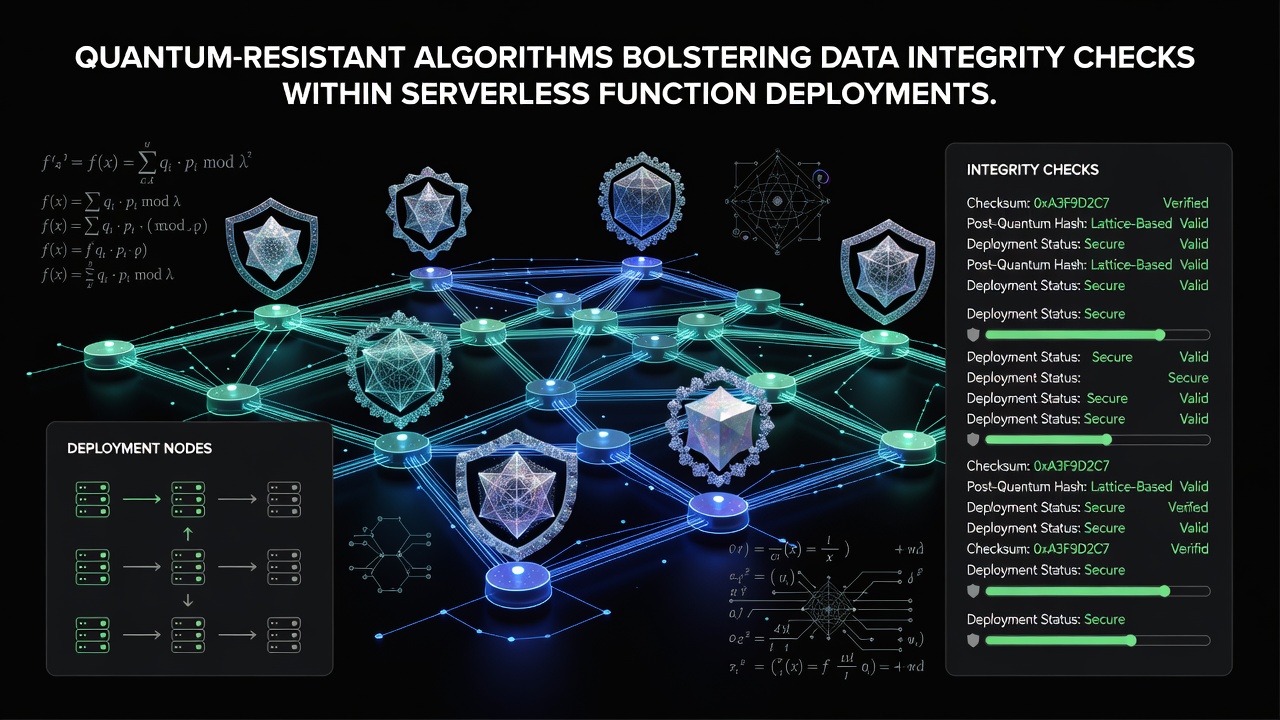
European research institutions, including those affiliated with the European Union Agency for Cybersecurity, have published comparative performance data showing that optimized implementations of Dilithium achieve verification speeds comparable to classical ECDSA on current serverless hardware when batch processing multiple inventory records. These findings support gradual rollout strategies that begin with high-value warehouse locations before expanding to edge facilities. Observers note that hybrid schemes combining classical and post-quantum signatures provide an interim bridge during transition periods, allowing systems to maintain compatibility while quantum-resistant components undergo further validation.
Performance Considerations and Geographic Deployment Data
Performance benchmarks collected across North American and Asia-Pacific regions indicate that the added computational cost of quantum-resistant signatures stays within acceptable bounds for inventory applications when functions are configured with adequate memory allocations. Australian government technology assessments released in early 2026 highlighted similar outcomes for supply chain platforms handling perishable goods, where sub-second verification remains essential to prevent spoilage-related losses. The studies emphasized that careful key rotation policies and hardware security module integration further reduce exposure surfaces without compromising the stateless nature of serverless execution.
Organizations track integrity failures through centralized logging systems that record signature verification outcomes alongside inventory delta values, enabling rapid detection of anomalies that might indicate attempted tampering. Data from Canadian research consortia demonstrates that platforms adopting these measures experienced measurable decreases in audit remediation time because cryptographic evidence could be replayed independently of the original serverless execution environment.
Future Standardization and Operational Readiness
Continued refinement of implementation libraries focuses on reducing memory footprints so that quantum-resistant operations fit comfortably within the resource limits imposed by many serverless providers. Academic groups continue publishing side-channel resistance analyses that inform secure coding practices for these new primitives, particularly when functions process sensitive pricing or supplier information alongside quantity data. As adoption widens, industry reports project that quantum-resistant data integrity mechanisms will become baseline requirements for any real-time tracking system handling cross-border logistics by the end of the decade.
Conclusion
Quantum-resistant algorithms now supply verifiable protection for data integrity checks executed inside serverless functions that power real-time inventory platforms. Standards bodies and research organizations across multiple continents have supplied the technical foundation, while practical deployments demonstrate compatibility wth existing event-driven workflows. Continued monitoring of performance metrics and cryptographic developments will guide further refinements as these techniques move from pilot implementations toward widespread operational use.