Sensor Fusion from Wearables Driving Real-Time Layout Adjustments in Location-Aware Educational Portals
Elena Krause · Aug 18, 2026
Sensor Fusion from Wearables Driving Real-Time Layout Adjustments in Location-Aware Educational Portals
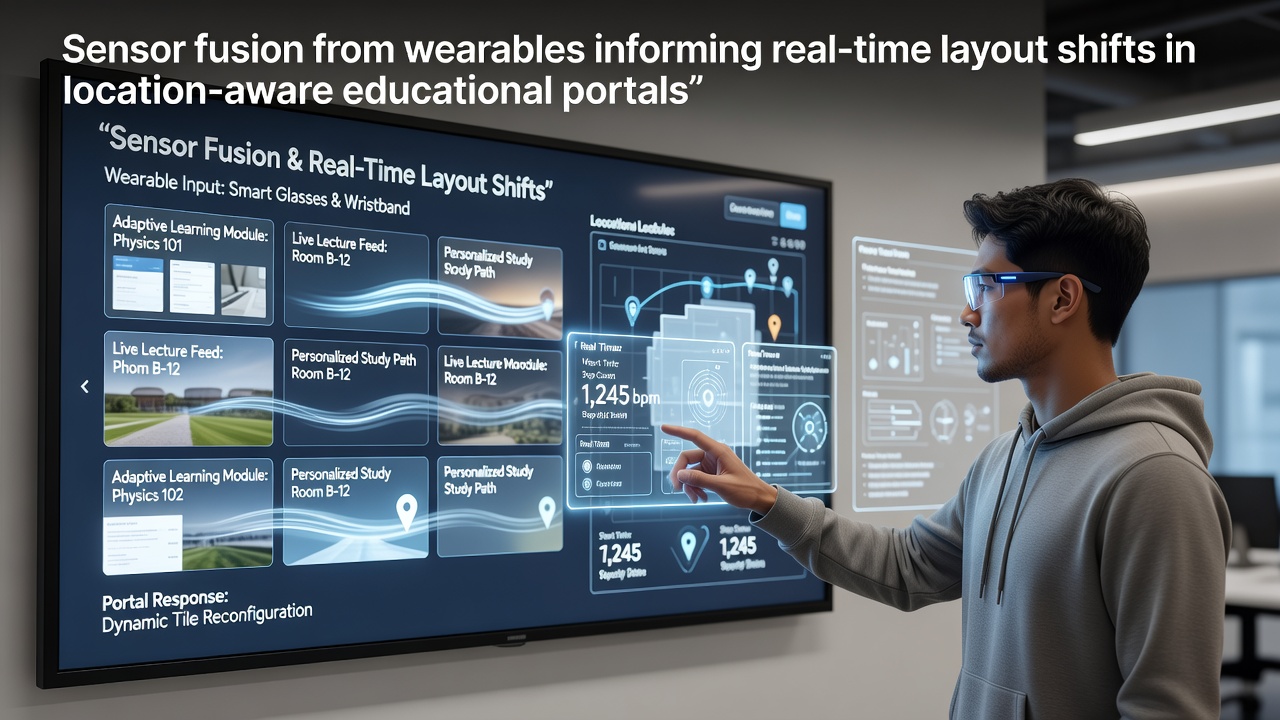
Researchers combine accelerometer, gyroscope, magnetometer, and GPS readings from wearables through sensor fusion algorithms that produce unified motion and position estimates, and these estimates trigger layout changes inside location-aware educational portals without requiring separate user inputs. Fusion pipelines often rely on Kalman filters or particle filters to reconcile noisy signals from multiple sensors, while educational platforms receive the processed outputs through secure APIs that update interface elements such as navigation menus, content panels, and resource recommendations. In August 2026 several university networks began testing these integrations at scale, with data streams flowing from student-worn devices directly into portal servers hosted on edge computing nodes near campus buildings.
How Sensor Fusion Processes Wearable Inputs
Multiple sensor streams arrive at different sampling rates, so fusion engines first align timestamps and apply calibration offsets before running state estimation routines that output a single coherent user state vector containing position, velocity, and activity classification. Educational portals subscribe to these vectors and map specific states to layout rules, for example shifting a reading pane to larger text when the system detects a user walking between lecture halls or surfacing lab safety checklists when proximity beacons place the user inside a chemistry building. Studies published by academic teams show that fused data reduces location error by up to 40 percent compared with GPS alone in indoor-outdoor transition zones common on university campuses.
Location Detection in Educational Settings
Bluetooth Low Energy beacons, Wi-Fi fingerprinting, and visual markers supplement wearable GPS when satellite signals degrade inside buildings, and the combined dataset feeds into portal logic that recognizes zones such as libraries, laboratories, or collaborative study areas. Portal developers define geofenced regions in advance, then link each region to predefined CSS and JavaScript rules that reorder page components or preload context-specific modules. Observers note that this approach maintains accessibility standards because layout shifts remain keyboard-navigable and respect user preferences stored in profile settings.
Real-Time Layout Shifts and Portal Architecture
Layout engines inside the portals listen for state-change events broadcast from the fusion service, then apply targeted DOM updates that preserve scroll position and form data whenever possible. When a student transitions from a seated lecture to movement across campus, the system may collapse sidebar resources into a collapsible drawer while expanding a map-based navigation widget. Data indicates these adjustments occur within 800 milliseconds on average when edge nodes handle the fusion workload, allowing interfaces to respond before the next user interaction. Integration teams often embed feature flags so institutions can roll out new layout mappings gradually and monitor engagement metrics through anonymized telemetry.
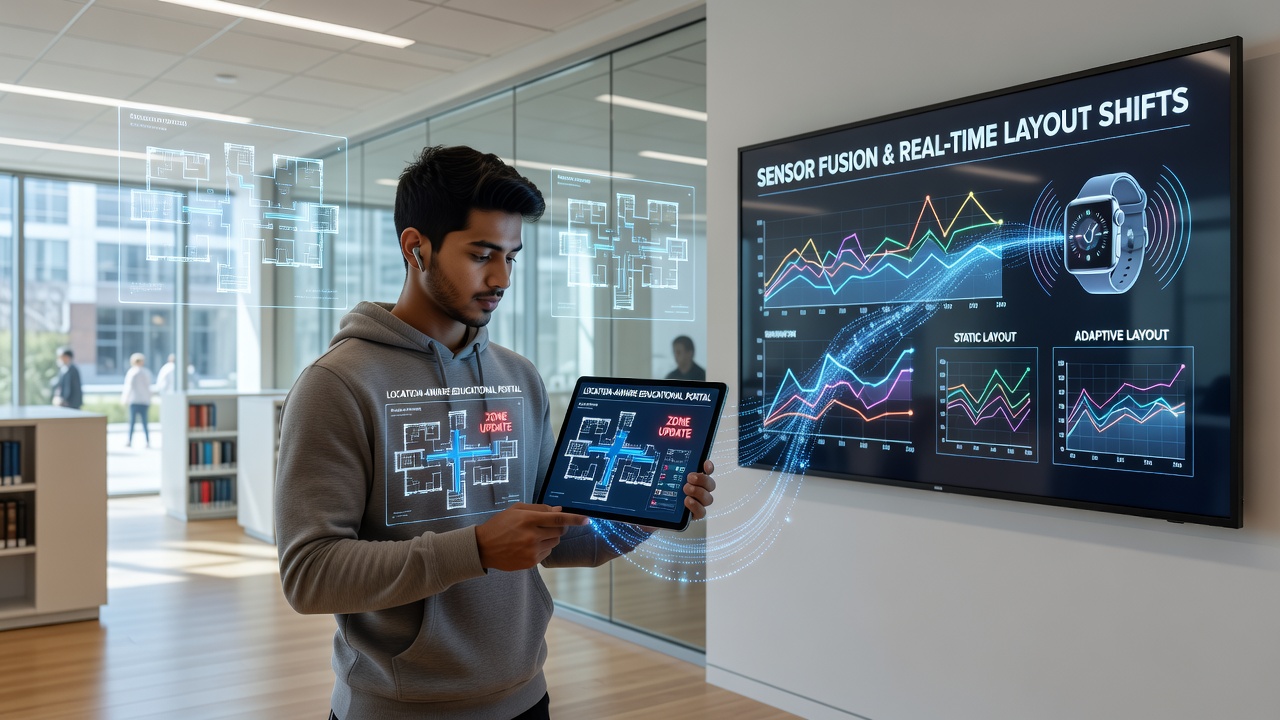
Security layers encrypt sensor streams end-to-end and strip personally identifiable information before the data reaches layout decision modules, satisfying requirements outlined in institutional review board guidelines. Developers also implement fallback modes that disable automatic shifts if battery levels on wearables drop below defined thresholds or if users opt out through device settings.
Implementation Examples Across Institutions
One deployment at a North American research university routes fused data from smartwatches into a portal that rearranges assignment due dates and discussion threads according to whether students are detected in residential zones or active research facilities. Another pilot coordinated by European higher-education consortia uses similar pipelines to surface language-support overlays when learners enter international exchange offices. Figures from these projects reveal that session durations increased when layout changes aligned with physical context, though teams continue refining rules to avoid over-triggering during brief movements.
Technical Considerations and Standards
Standard bodies such as the IEEE have published recommended practices for wearable data formats that facilitate interoperability between device manufacturers and portal vendors. IEEE sensor fusion guidelines emphasize consistent coordinate frames and uncertainty reporting so educational platforms can apply appropriate confidence thresholds before executing layout changes. Meanwhile, government agencies including the U.S. Department of Education have issued technical briefs on data minimization practices that apply directly to location streams used for interface adaptation. Portal architectures typically separate the fusion service from the rendering layer through event buses, allowing independent scaling and easier compliance audits.
Conclusion
Sensor fusion techniques applied to wearable inputs continue to expand the capabilities of location-aware educational portals by supplying reliable context signals that drive automatic layout adjustments. Institutions adopting these systems report measurable gains in resource discoverability when interfaces respond to verified physical states, and ongoing work focuses on tightening privacy controls while maintaining responsiveness across diverse campus environments. As device capabilities and network infrastructure evolve, the same fusion principles support additional features such as predictive content loading based on movement patterns detected in real time.