The Synchronization Challenges of Multi-Device Sessions in Modern Web-Based Productivity Suites
Rafael Brooks · Aug 20, 2026
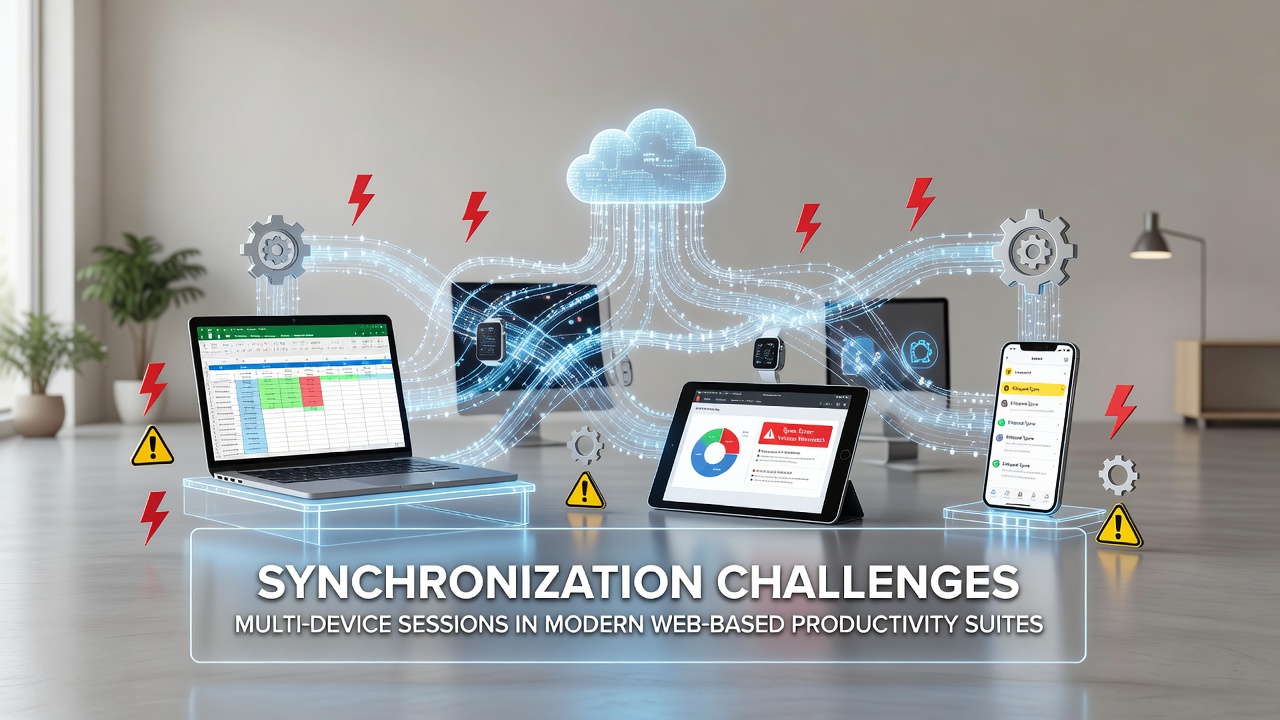
The Synchronization Challenges of Multi-Device Sessions in Modern Web-Based Productivity Suites
Modern web-based productivity suites such as Google Workspace and Microsoft 365 handle millions of simultaneous multi-device sessions each day, yet synchronization remains a persistent technical hurdle that developers address through operational transformation and conflict-free replicated data types. These systems must maintain consistent document states across smartphones, tablets, laptops, and desktops while users switch contexts without interruption, and data from industry reports shows that network variability often disrupts this process. Observers note that as of August 2026, adoption rates for collaborative editing features have climbed steadily, driven by hybrid work patterns that require seamless handoffs between devices.
Core Mechanisms Behind Session Synchronization
Productivity platforms rely on algorithms that track every keystroke and cursor movement as discrete operations, then broadcast those changes to all connected clients for local application. Researchers have documented how operational transformation resolves overlapping edits by reordering commands according to predefined rules, whereas conflict-free replicated data types allow independent updates that merge automatically upon reconnection. Studies from academic institutions indicate that these approaches reduce data loss incidents by measurable percentages, although they introduce computational overhead that scales with the number of active participants in a session.
Network latency introduces further variables because packets carrying edit information can arrive out of sequence or experience delays across different geographic regions. Engineers at major providers implement buffering strategies and priority queues to prioritize recent changes, yet intermittent connectivity still forces reliance on offline queues that must reconcile upon return to an active network. Figures from cloud infrastructure analyses reveal that synchronization failures peak during peak usage hours in densely populated urban centers where bandwidth contention rises sharply.
Security adn Consistency Trade-Offs
Multi-device sessions expose additional attack surfaces because each endpoint maintains a local copy of the document state that requires periodic verification against a central authority. According to guidance issued by the European Union Agency for Cybersecurity, encryption of operational logs during transit and at rest helps mitigate interception risks, while access controls limit which devices can initiate or accept synchronized updates. Data integrity checks become essential when sessions span multiple time zones, as clock skew between devices can trigger false conflict detections that waste processing cycles.

One case that experts examined involved a large enterprise deployment where mobile users experienced repeated merge failures after switching from cellular to Wi-Fi networks mid-document. The resolution involved tighter timestamp granularity combined with vector clocks that track causality across all replicas, a technique now referenced in multiple technical whitepapers. Those who have analyzed production logs report that such refinements lowered reconciliation times without compromising the real-time feel users expect from these platforms.
Scalability Pressures in Growing User Bases
As organizations expand their use of web-based suites, the volume of concurrent operations per document increases, pushing synchronization engines toward distributed architectures that shard responsibility across multiple servers. Reports compiled by research groups at institutions such as the National Institute of Standards and Technology highlight how sharding strategies must preserve session affinity to avoid routing edits to incorrect replicas. Load balancers therefore incorporate session identifiers that persist across device handoffs, although this adds another layer of state management that can introduce single points of failure if not redundantly deployed.
What's interesting is that browser-based environments impose their own constraints through JavaScript execution limits and memory caps that vary by vendor implementation. Developers therefore optimize payload sizes for each operation broadcast, compressing metadata while preserving enough context for accurate merging on the receiving end. Performance metrics gathered in 2026 demonstrate that suites employing these optimizations sustain higher user counts per document before noticeable lag appears.
Conclusion
Synchronization challenges in multi-device productivity sessions stem from the interplay of algorithmic complexity, network conditions, security requirements, and scaling demands that continue to evolve alongside usage patterns. Providers address these through iterative refinements to transformation engines and distributed consistency models, supported by ongoing measurements from infrastructure providers and regulatory bodies. Continued attention to these technical elements supports reliable collaboration across the expanding range of connected devices in professional environments.