Tracing the Adoption Patterns of WebRTC Protocols in Peer-to-Peer Video Conferencing Tools for Remote Healthcare Consultations
Ines Lehmann · Aug 22, 2026
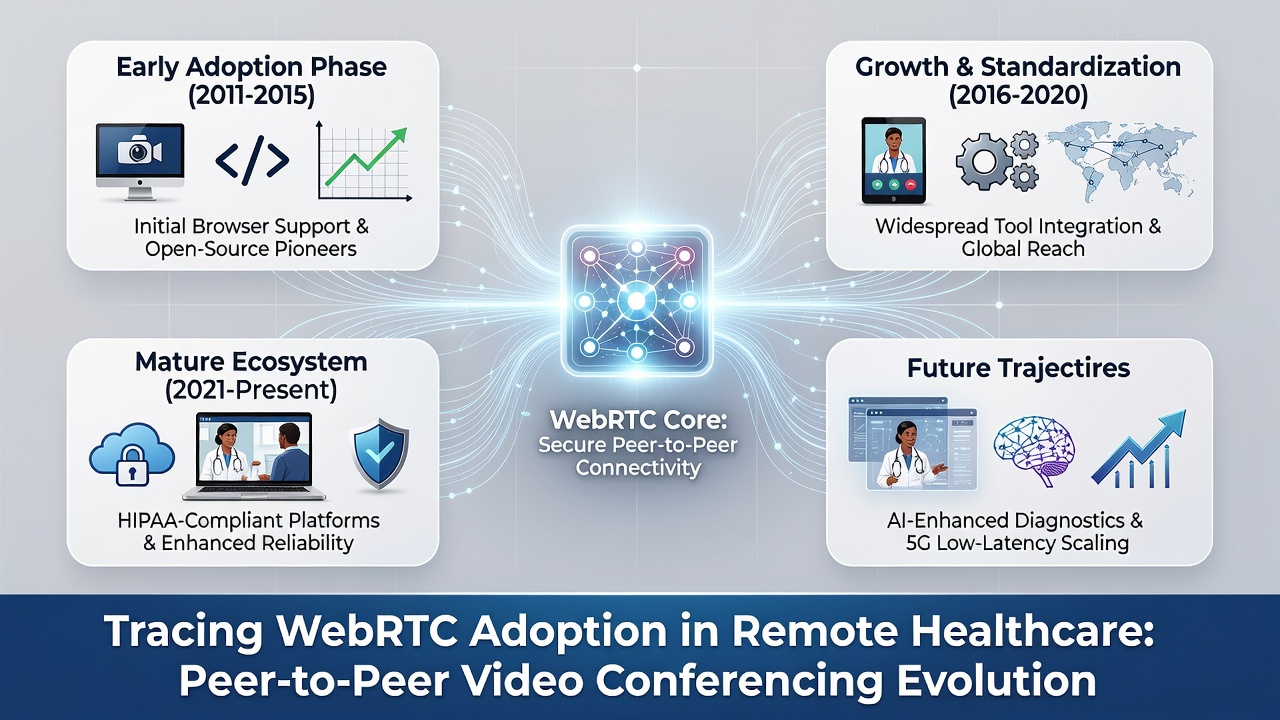
Tracing the Adoption Patterns of WebRTC Protocols in Peer-to-Peer Video Conferencing Tools for Remote Healthcare Consultations
WebRTC protocols enable direct browser-to-browser video and audio exchanges without plugins or additional software installations, and their integration into peer-to-peer video conferencing tools has followed distinct adoption curves in remote healthcare consultations since the mid-2010s. Researchers tracking these patterns note that initial implementations focused on reducing latency in real-time consultations, while later phases emphasized security enhancements and cross-platform compatibility. Data from industry reports shows steady uptake in North America and Europe between 2018 and 2022, with acceleration driven by regulatory approvals for virtual care delivery during public health emergencies.
Early Integration Patterns in Telehealth Systems
Healthcare providers began experimenting with WebRTC in video tools around 2014, primarily through open-source libraries that supported direct peer connections for patient-provider interactions. Studies from academic institutions indicate that early adopters prioritized low-bandwidth scenarios common in rural areas, where traditional server-relayed streams proved unreliable. By 2019, platforms such as those used in primary care networks incorporated WebRTC signaling servers to manage session initiation, resulting in documented reductions in connection failures during consultations. Those who analyzed deployment logs observed that adoption clustered around organizations already invested in electronic health record systems, since integration required API bridges to maintain patient data privacy standards.
Growth Drivers and Regional Variations Through 2025
Expansion accelerated after 2020 as regulatory bodies in multiple countries expanded reimbursement policies for remote services, prompting vendors to embed WebRTC directly into mobile applications and web portals. Figures from the Australian Digital Health Agency reveal that telehealth consultations using peer-to-peer protocols increased by over 300 percent in certain states between 2020 and 2023, with similar trajectories reported in Canadian provincial health networks. In the European Union, directives on cross-border healthcare data flows encouraged standardized WebRTC implementations that complied with encryption requirements under existing data protection frameworks. What's interesting is how adoption patterns diverged by region: North American systems emphasized scalability for high-volume urban clinics, whereas Asia-Pacific deployments often focused on interoperability with legacy telemedicine hardware.
By mid-2026, updates to browser engines further streamlined WebRTC performance, allowing seamless scaling across devices used in home monitoring programs. Researchers at institutions examining usage metrics found that tools leveraging these protocols handled simultaneous multi-party sessions more efficiently than earlier TURN-server dependent alternatives, particularly in scenarios involving specialists consulting with primary care teams and patients together.
Technical Adoption Milestones and Platform Examples
Key milestones include the widespread support for WebRTC data channels in healthcare applications starting in 2022, which enabled secure file sharing of diagnostic images alongside video streams. Observers tracking vendor roadmaps note that major conferencing suites adopted adaptive bitrate algorithms native to the protocol, improving stability on variable mobile networks common among patients in remote locations. One documented case involved a network of European clinics that transitioned their consultation platforms to full WebRTC stacks, achieving measurable decreases in infrastructure costs associated with centralized media servers. And yet integration challenges persisted around firewall traversal and device-specific codec support, leading developers to refine STUN and ICE candidate gathering processes tailored for medical environments.
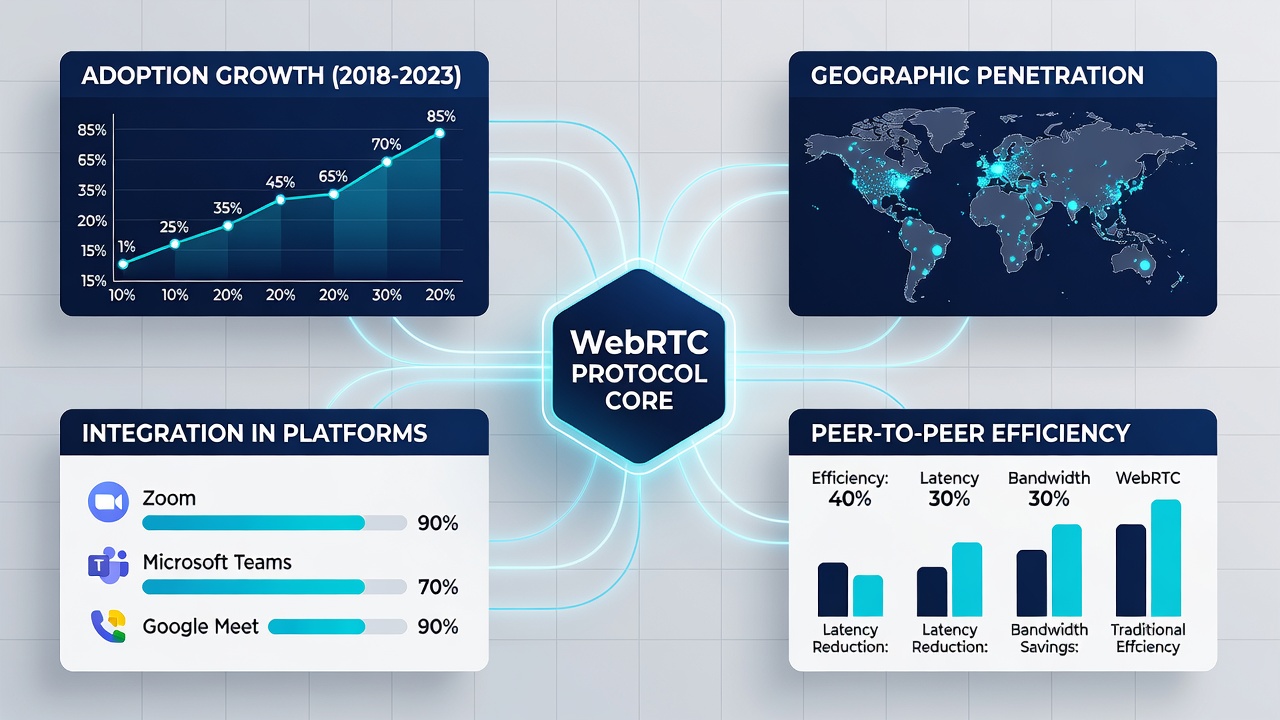
Platform-specific patterns show that smaller startups often led experimentation with advanced WebRTC features such as end-to-end encryption extensions, while larger established vendors prioritized backward compatibility for older patient devices. Data compiled by research groups at the University of Toronto highlights that between 2023 and 2025, peer-to-peer video tools accounted for an increasing share of total telehealth minutes in primary care, driven by improved NAT traversal techniques that reduced reliance on relay servers.
Security Considerations and Compliance Evolution
Security implementations within WebRTC have shaped adoption rates, as healthcare applications demand compliance with standards for protected health information. Protocols built into the stack, including DTLS and SRTP, received enhancements through community contributions that addressed vulnerabilities identified in early deployments. According to analyses from the U.S. Department of Health and Human Services, organizations adopting updated WebRTC versions reported fewer incidents related to unauthorized access during consultations. But here's the thing: regional differences in certification processes sometimes slowed rollout, with some jurisdictions requiring additional audits before approving new peer-to-peer configurations for clinical use.
Trends Observed in August 2026
As of August 2026, monitoring dashboards from health IT consortia indicate continued refinement of WebRTC-based tools for specialized applications such as remote physical therapy assessments and mental health follow-ups. Patterns suggest growing incorporation of supplementary features like real-time transcription overlays that leverage the protocol's low-latency data pathways. Those examining global deployment statistics note that adoption remains strongest in systems where broadband access has expanded, while gaps persist in areas with inconsistent connectivity. Evidence from ongoing pilots shows that hybrid models combining WebRTC peer connections with selective cloud fallback continue to gain traction among providers managing diverse patient populations.
Conclusion
Overall, the trajectory of WebRTC protocols in peer-to-peer video conferencing for remote healthcare reflects incremental technical refinements paired with policy support across different healthcare systems. Continued monitoring of connection metrics and compliance updates will likely determine how these tools evolve to meet emerging consultation demands in subsequent years.