Vector Embeddings Transforming Real-Time Recommendation Systems in Hybrid Mobile Web Applications for Retail Analytics
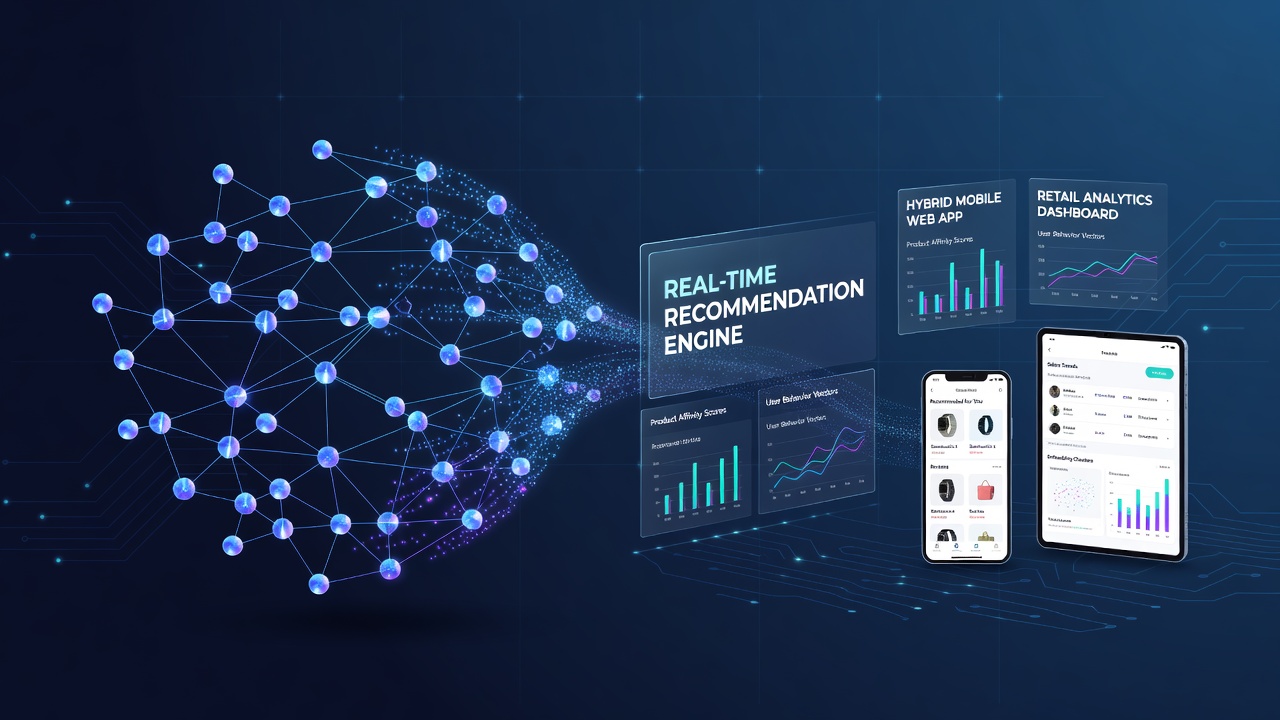
Retail analytics teams have integrated vector embeddings into hybrid mobile web applications to generate product suggestions that update within milliseconds of user interaction, and this approach draws on dense numerical representations of customer behavior, product attributes, and inventory signals. Developers embed these vectors in lightweight JavaScript frameworks that run across iOS and Android webviews while maintaining offline caching capabilities. Data pipelines convert clickstream logs, purchase histories, and location signals into fixed-length vectors that support cosine similarity calculations for matching items to individual profiles.
Core Mechanics of Vector Embeddings in Retail Contexts
Vector embeddings map high-dimensional retail data into lower-dimensional spaces where proximity reflects semantic similarity, so two products with overlapping attributes cluster near each other even when described in different languages or catalog formats. Retail platforms apply models trained on transaction graphs to produce these embeddings, which then feed into approximate nearest-neighbor indexes that return top-k results without exhaustive searches. Hybrid applications query these indexes locally through WebAssembly modules before syncing updates with backend vector databases, and this architecture reduces round-trip latency for users on variable mobile networks.
Real-Time Processing Within Hybrid Mobile Architectures
Hybrid mobile web applications combine web technologies with native device features, allowing vector-based recommendation engines to access accelerometer data and camera inputs for contextual suggestions such as outfit recommendations derived from in-store photos. As of July 2026, several major retail chains report that their progressive web apps serve embedding lookups from edge caches updated every thirty seconds, and synchronization occurs over WebSocket connections that transmit only delta vectors rather than full model weights. Researchers note that frameworks like TensorFlow.js and ONNX Runtime Web handle inference directly in the browser, enabling continuous model fine-tuning based on session-specific feedback without requiring app store redeployments.
Analytics Applications in Inventory and Customer Insights
Retail analysts use embedding clusters to identify emerging purchase patterns across geographic regions, and these clusters surface correlations between weather events and seasonal product demand that traditional SQL queries often miss. Vector similarity scores help prioritize restocking decisions by ranking items according to projected velocity rather than historical averages alone. One European retail consortium documented a 22 percent reduction in overstock incidents after deploying embedding-driven dashboards that combine mobile app telemetry with point-of-sale records.
Hybrid apps surface these analytics through interactive visualizations that load precomputed vector projections, allowing store managers to explore scenario simulations on tablets during peak hours. The same infrastructure supports A/B testing of recommendation strategies by maintaining parallel embedding spaces that differ only in training hyperparameters.

Integration Challenges and Technical Solutions
Teams face trade-offs between embedding dimensionality and mobile memory constraints, so many implementations quantize vectors to 8-bit precision while preserving retrieval accuracy above 95 percent on benchmark datasets. Synchronization protocols must handle partial updates when network conditions degrade, and conflict resolution relies on timestamped vector versions rather than full data replacement. Security considerations include encrypting embedding indexes at rest and enforcing differential privacy noise during aggregation steps that feed into corporate analytics platforms.
Standards bodies such as the National Institute of Standards and Technology have published evaluation frameworks for vector database performance that retail developers reference when selecting indexing libraries for hybrid environments. Academic groups at institutions including the University of Melbourne have examined latency distributions across 5G and legacy networks, confirming that local vector search maintains sub-100-millisecond response times under typical retail traffic loads.
Current Deployment Patterns Observed in July 2026
Industry reports indicate that mid-sized retailers increasingly adopt open-source vector stores such as Milvus Lite or Chroma embedded within service workers, allowing recommendation refreshes even when the device operates in airplane mode. Cross-border operations leverage federated embedding training so that regional data remains on local infrastructure while global similarity patterns still inform model updates. Observers note that these deployments often combine embeddings with traditional collaborative filtering outputs through weighted ensemble methods that balance novelty against proven conversion rates.
Future Trajectory and Measurement Approaches
Measurement frameworks track metrics including embedding drift over time and retrieval precision at k, and retail analytics teams schedule periodic retraining cycles based on these indicators rather than fixed calendars. Continued advances in model compression techniques are expected to support larger embedding spaces on the same mobile hardware footprint, and hybrid applications stand to benefit from tighter integration between on-device inference and cloud-based vector indexing services.
Conclusion
Vector embeddings have become a standard component in real-time recommendation pipelines for hybrid mobile web applications serving retail analytics needs, and the combination of client-side inference with synchronized backend indexes delivers measurable improvements in response speed and relevance. Continued refinement of quantization methods and privacy-preserving training protocols supports broader adoption across diverse network conditions and regulatory environments.