WebAssembly Accelerates Complex Simulations in Scientific Research Platforms Without Traditional Server Dependencies

WebAssembly runs compiled code from languages such as C++, Rust, and Fortran inside web browsers at near-native speeds, and this capability lets research platforms handle intricate simulations locally on user devices. Teams in physics, biology, and climate science compile existing codebases into WebAssembly modules which execute calculations without round trips to remote servers for each step.
Browser environments now support WebAssembly threads, SIMD instructions, and garbage collection proposals that matured by 2025, while these features allow models previously reserved for high-performance clusters to operate in distributed settings. Data from the National Institute of Standards and Technology shows growing adoption of client-side numerical methods in materials science workflows where latency from network calls previously limited interactive exploration.
Core Technical Advantages in Research Contexts
Traditional server-dependent platforms transmit input parameters to remote machines, wait for results, then return visualizations, yet WebAssembly shifts the compute burden to the client so intermediate results stay resident in memory. Researchers therefore adjust parameters in real time while watching molecular dynamics trajectories update instantly, and the same pattern applies to finite-element analysis of structural components under load. Memory safety guarantees within the WebAssembly linear memory model prevent common buffer issues that plague native desktop ports, and sandboxing keeps untrusted modules isolated from the rest of the system.
Compilation pipelines using Emscripten or wasm-pack produce optimized binaries from legacy Fortran weather models or C++ molecular docking code, and these binaries load once then run repeatedly without reinstallation. Observers note that bandwidth consumption drops sharply because only initial module delivery and occasional result exports cross the network, whereas continuous data streaming becomes unnecessary.
Deployment Patterns Across Disciplines
Bioinformatics groups embed protein-folding kernels directly into web portals so collaborators worldwide examine conformations without installing specialized software or queuing jobs on shared clusters. Astrophysicists simulate gravitational wave propagation through browser tabs during collaborative review sessions, and the approach removes the requirement for institutional VPN access to dedicated compute nodes. Climate researchers at institutions across multiple continents load ensemble forecast modules that process regional downscaling calculations locally, while aggregated statistics upload only when users choose to share findings.
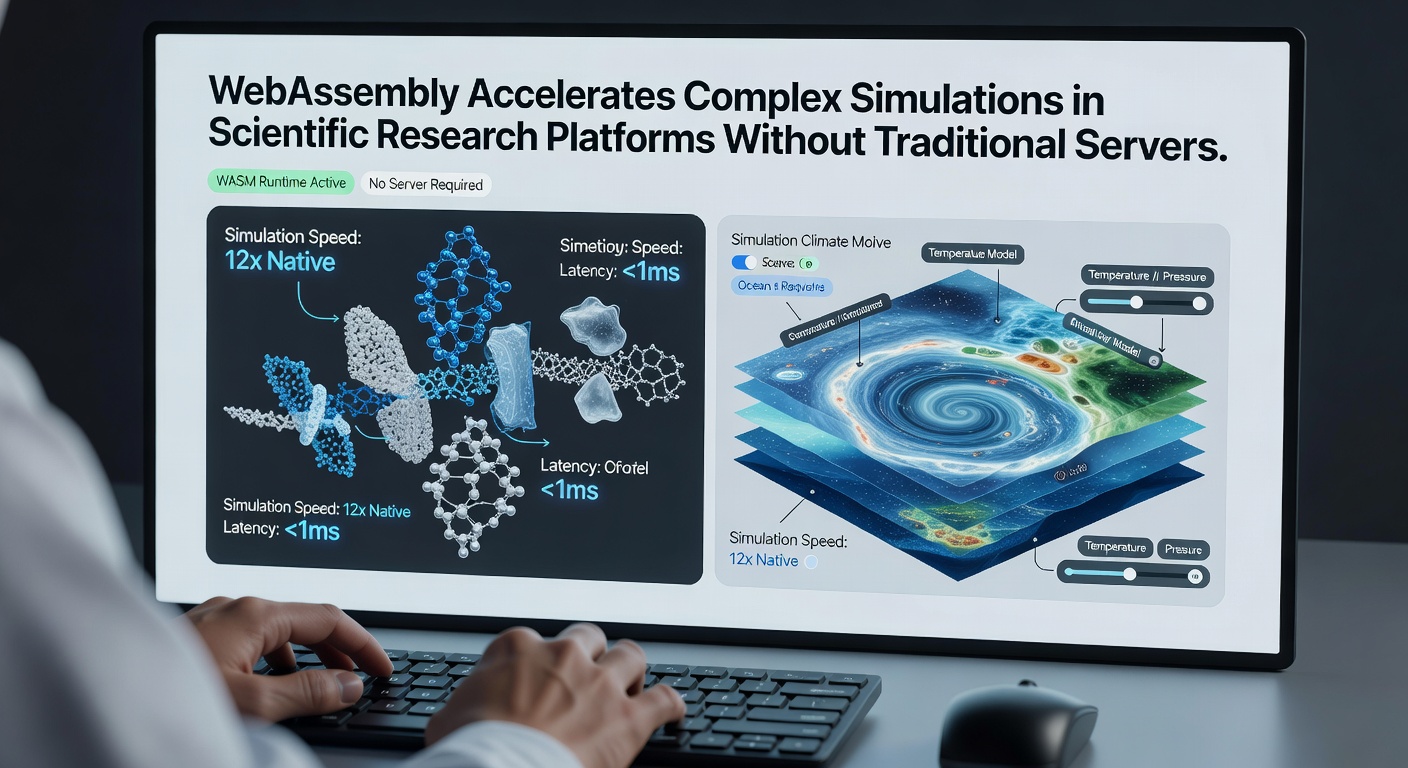
Platform developers integrate WebAssembly with WebGPU for hardware-accelerated rendering of volumetric data, and this combination supports visualization of large simulation outputs without server-side rendering farms. As of May 2026 several open-source libraries expose standardized bindings that let JavaScript front ends control simulation state machines written in compiled languages, and versioned module registries simplify reproducibility across different browser vendors.
Security and Reproducibility Considerations
Each WebAssembly module carries a static import list and explicit memory limits that hosting platforms can audit before execution, while content-security policies restrict network access for modules handling sensitive experimental data. Reproducibility improves because the same binary produces identical floating-point results across operating systems, eliminating discrepancies that arise from differing compiler toolchains or library versions on user workstations. Government-funded repositories in Canada and the European Union now archive WebAssembly snapshots alongside source code and input decks, creating verifiable records of published simulation outcomes.
Performance benchmarks published by academic consortia indicate that certain linear-algebra kernels achieve 70 to 90 percent of native throughput inside current browser engines, and these figures continue to rise as just-in-time optimizers incorporate profile-guided feedback from actual research workloads. Edge cases involving very large memory footprints still trigger paging to disk, yet incremental streaming compilation techniques keep startup times acceptable even for multi-gigabyte datasets.
Integration With Existing Research Infrastructure
Many groups wrap established libraries such as PETSc or deal.II behind thin WebAssembly interfaces, and these interfaces expose only the subset of functions needed for a given workflow. Container orchestration systems that previously launched server instances now generate WebAssembly artifacts as an additional deployment target, allowing the same codebase to serve both cloud batch jobs and interactive browser sessions. Observers tracking adoption patterns report that training workshops increasingly include WebAssembly compilation exercises alongside traditional high-performance computing tutorials.
Interoperability with IndexedDB and WebRTC enables peer-to-peer exchange of intermediate simulation checkpoints, reducing dependence on centralized storage while maintaining audit trails through cryptographic hashes of module outputs. Funding agencies in Australia and the United States have begun accepting WebAssembly-based supplementary materials in grant proposals because reviewers can rerun selected analyses directly from browser links.
Conclusion
WebAssembly therefore shifts the execution model for scientific simulation from server-centric to client-centric architectures, and this shift expands access while lowering operational overhead. Continued standardization work on threads, exception handling, and interface types promises further reductions in the gap between browser and native performance, allowing an expanding range of research codes to operate independently of persistent server infrastructure.